Our team received a mobile game GDD and shipped hi-fi Figma mockups—but first we surveyed real players, audited the market, and built personas so the UI and positioning spoke to people who actually play on phones.
Role
UI Artist / UX Designer
Team
5 · UX-focused design team
Tools
Figma, Qualtrics, Google Sheets
Deliverable
Mobile hi-fi UI mockups
20Survey Responses
5Comp Titles Audited
3Research Personas
5GDD UX Pillars
The Assignment
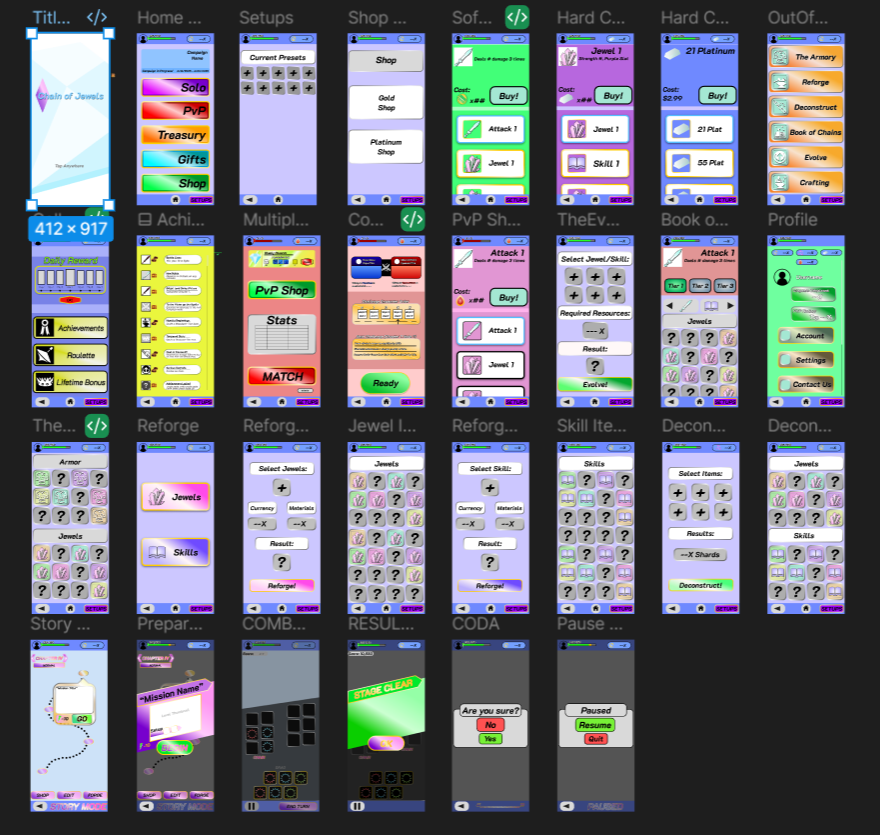
We were given a game design document for Chain of Jewels, a mobile match-3 with character progression and gear. The deliverable was not greybox gameplay—it was mobile UI wireframes and hi-fi mockups in Figma that respected the GDD’s UX pillars and a real audience.
The Approach
Research came first: a Qualtrics survey (20 responses), competitive analysis of five live titles, and three personas. We used snowball sampling to reach mobile-heavy players, then let those patterns drive both who we marketed to and how Barbara—the primary persona—walked through our clickable prototype.
01
Context & Team
Five UX-focused teammates shared production, design, and art on mockups. I contributed to survey outreach, data analysis, competitive write-ups, and the secondary persona.
What we designed
Phone-first flows for combat, progression, and navigation—especially an ideal combat state that shows match-3 readability, character presentation, and outcome feedback at once.
What we measured
Whether respondents actually play on mobile, what genres they return to, and how they feel about monetization—so personas were grounded in data, not a fictional “puzzle player” brief alone.
02
Survey & Synthesis
We kept questions easy to answer while still capturing useful signal, and targeted an audience with plenty of mobile play time. Snowball sampling helped us find those players quickly and heavily influenced persona design.
Universal distaste for microtransactions and heavy ad load—even among players who spend the most (FOMO and buyer's remorse).
Older players gravitate toward puzzle games and simpler mobile experiences.
Younger players list content-heavy titles: gacha, Pokémon, and high-production strategy games.
Every respondent still named addicting puzzle games as a go-to genre—shaping our primary and secondary personas.
Single respondents reported longer play sessions and larger game libraries, correlating with higher spend on mobile.
03
Competitive Analysis
We documented five top-grossing-style titles that share DNA with Chain of Jewels—match-3 or squad combat, gear progression, and replayable stages—to see how they communicate power, farming, and clarity on a small screen.
Project Sekai
Rhythm battles ranked S–F; strong ranks unlock autoplay to farm rewards—clear performance feedback and repeat-friendly loops.
Star Wars: Galaxy of Heroes
Sequential missions with energy-based replays for farming; combat offers multiple ability choices per encounter.
DC Heroes & Villains: Match 3
Color-coded match-3 combat tied to characters and damage types, with gear upgrades and character progression.
Raid: Shadow Legends
Squad-based abilities upgraded through gear; contained levels built for revisiting and farming.
Puzzle & Dragons
Match-3 combat with a large character roster, steady item progression, and long-term upgrade paths.
04
Personas
Primary and secondary personas both love puzzle loops on mobile; tertiary John anchors what we shouldnot assume about every player—he wants depth and hates mobile monetization noise.
Primary persona
Barbara · Travel Gamer
Female · 54 · Married · Teacher / educator
Early childhood education degree; private-school teaching job; three kids. Plays mobile games in short gaps between classes when she is not busy.
Motivations
Easy, casual, accessible, good for the brain.
Frustrations
Flows that require inviting friends to proceed; experiences that feel too committal or too addicting.
Ideal experience
Uses puzzle skills to clear levels quickly, hits leaderboard status, and can show friends progress through in-app support—without heavy social pressure.
Secondary persona
Ashley · Casual Gamer
Female · 25 · Single · Nursing student / server
Nursing school and part-time service work; plays puzzle games on-call to relieve stress and pass time between shifts.
Small screens, poor controls, paywalls, lack of variety, shallow concepts.
Ideal experience
Substantial short-burst sessions that distract from stress, spark imagination, and always feel like forward progress.
Tertiary persona
John · Committed Player
Male · 36 · Married · QA specialist (tech)
Community college then public university; remote software career; prefers long evening sessions on console or PC over mobile.
Motivations
Unwinding with a long-commitment game after work.
Frustrations
Microtransactions and ads on mobile—opts for offline, single-player experiences instead.
Ideal experience
Large-scale worldbuilding, strong story, and solo escapism rather than multiplayer social play.
05
Audience & Marketing
Personas turned into a go-to-market story: who we pictured installing the game, what we promised them, and what we avoided because the survey said it would erode trust.
Lead with Barbara & Ashley
Both want low-commitment puzzle progress in stolen minutes—between classes or on-call shifts. Messaging emphasizes brain-teaser satisfaction, visible advancement (leaderboards, loadout flair), and no friend-gate to keep playing. The clickable prototype is roleplayed as Barbara’s journey so stakeholders see UI through her eyes.
Respect John’s skepticism
John reminds us that heavy IAP and ad pressure push experienced players back to console. For Chain of Jewels that meant highlighting craft, gear identity, and fair defeat feedback in UI copy and layout—not bargain-bin monetization patterns—while accepting that John is a secondary acquisition channel at best.
Positioning line
A fashion-forward match-3 where short sessions feel rewarding, screens never trap you, and losing teaches you what to upgrade next—built for puzzle lovers who are tired of being nickel-and-dimed.
06
GDD UX Pillars → UI
Milestone mockups mapped directly to the GDD’s experience goals—these were our checklist before hi-fi polish.
Pillar 1
Drip Contest
Combat is framed as a fashion competition—UI should celebrate flair and readable “who won the look” feedback.
Pillar 2
Become the Fanciest
Players bond with their best gear; screens need to showcase loadouts and upgrades without burying stats.
Pillar 3
Become a Big Shot
Power growth is core; progression, rewards, and combat outcomes should feel like rising status.
Pillar 4
Can't Get Lost
Every screen needs a clear exit—navigation and back affordances were treated as first-class requirements in wireframes.
Pillar 5
What Doesn't Kill You
Defeat teaches: loss states should surface what to improve next, not dead-end the player.
07
Figma Mockups
Hi-fi comps focus on class principles—hierarchy, touch targets, and readable combat states—not AAA art. Combat frames show the ideal case: board state, character presentation, and outcome at a glance.
Hub and presentation visuals from the team deck—pair with in-flow screens in the prototype below.
Explore the milestone prototype—flows are written for Barbara (primary persona) moving through combat and progression screens.