Narrative Case Study · Team Project
Two of Parts
A first-person blackjack game about grief, compulsion, and a robotic cowboy trying to win back the parts of his lover from a casino that never stops dealing.
The Premise
Two of Parts is set in a cyberpunk-meets-wild-west future. You play Jack, a grief-stricken robotic cowboy gambling for the literal parts of Penny, his lover—stolen and sold piece by piece by the house.
What I Owned
As narrative lead I shaped the world bible, dialogue structure, bark systems, and collectible lore. I documented the work the way strong narrative portfolios do: premise → constraints → systems → proof in-game—the same scannable case-study flow I use on solo UX work like myMinecraft inventory redesign.
Step 01
Context
Blackjack is the loop; narrative is the reason to stay in it. My job was to make the casino feel morally uncomfortable and emotionally specific without pulling players out of the table.
Narrative Goal
How might we tell a love story through systems—where every hand dealt and every part bought advances grief, not just progression?
Step 02
Constraints
These were the boundaries that shaped every narrative decision. Like UX requirements, they turned vague “more story” requests into deliverables the team could schedule.
No Real Pre-Production
Teams formed in week one. Narrative had to define tone, cast, and delivery formats fast enough for art and design to build in parallel.
Two Audiences at Once
Casual blackjack players needed clarity without friction. Story-focused players needed payoff without mandatory cutscenes.
Silent Protagonist
No VO budget for Jack. Emotion had to land through barks, UI copy, environment, and collectible text instead of performance.
Animation Limits
No cinematic pipeline. Anything that looked like a “cutscene” had to be reimagined as dialogue, artifacts, or environmental storytelling.
Step 03
Worldbuilding
I wrote a concise world bible before dialogue or artifacts so art and level design could own environmental storytelling. It stayed short on purpose: tone, factions, and character wants—not lore encyclopedias.
Step 04
Dialogue Systems
Dialogue had to do three jobs at once. I separated them the way narrative designers document “story layers”—so engineering and audio knew what to implement and when it fires.
Tutorialization
The bouncer sets tone and stakes on entry. Mr. Tortorial runs a no-stakes blackjack round on an abandoned dealer-bot—skippable for experienced players, essential for everyone else.
Ambience
The casino stays loud and indifferent. Patron and bouncer proximity barks sell a world that keeps moving while Jack is trapped in the loop.
Motivation
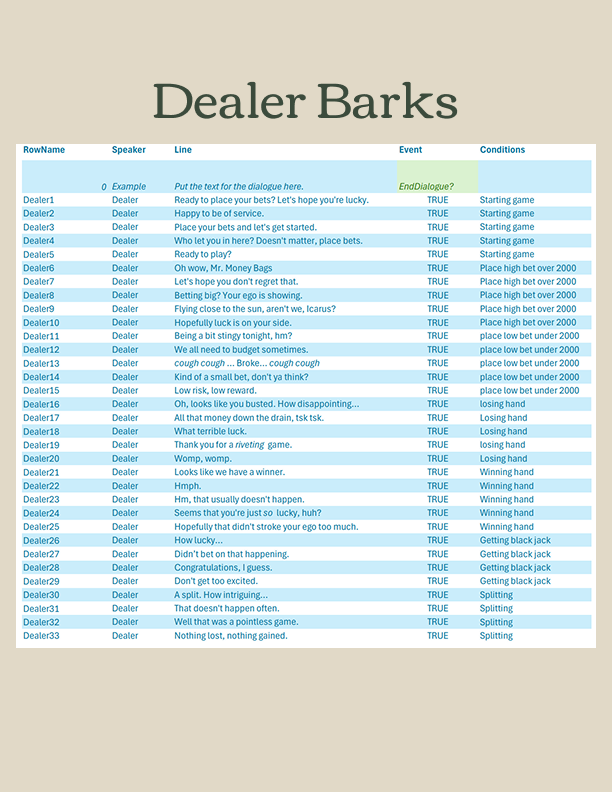
Dealer barks anchor the core loop—a snarky, condescending voice that playtesters cited as the reason they kept playing one more hand.
Step 05
In-Game Artifacts
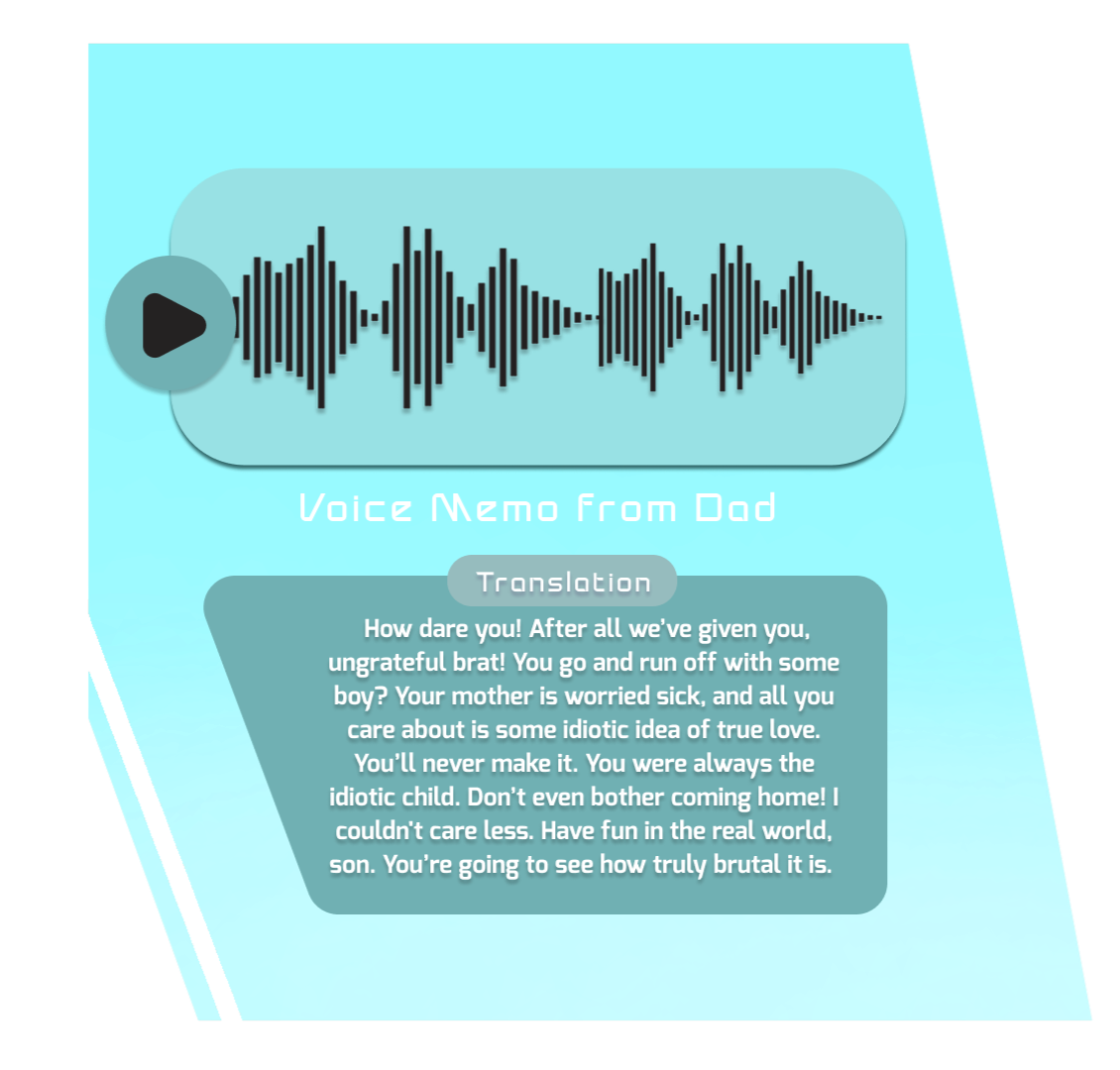
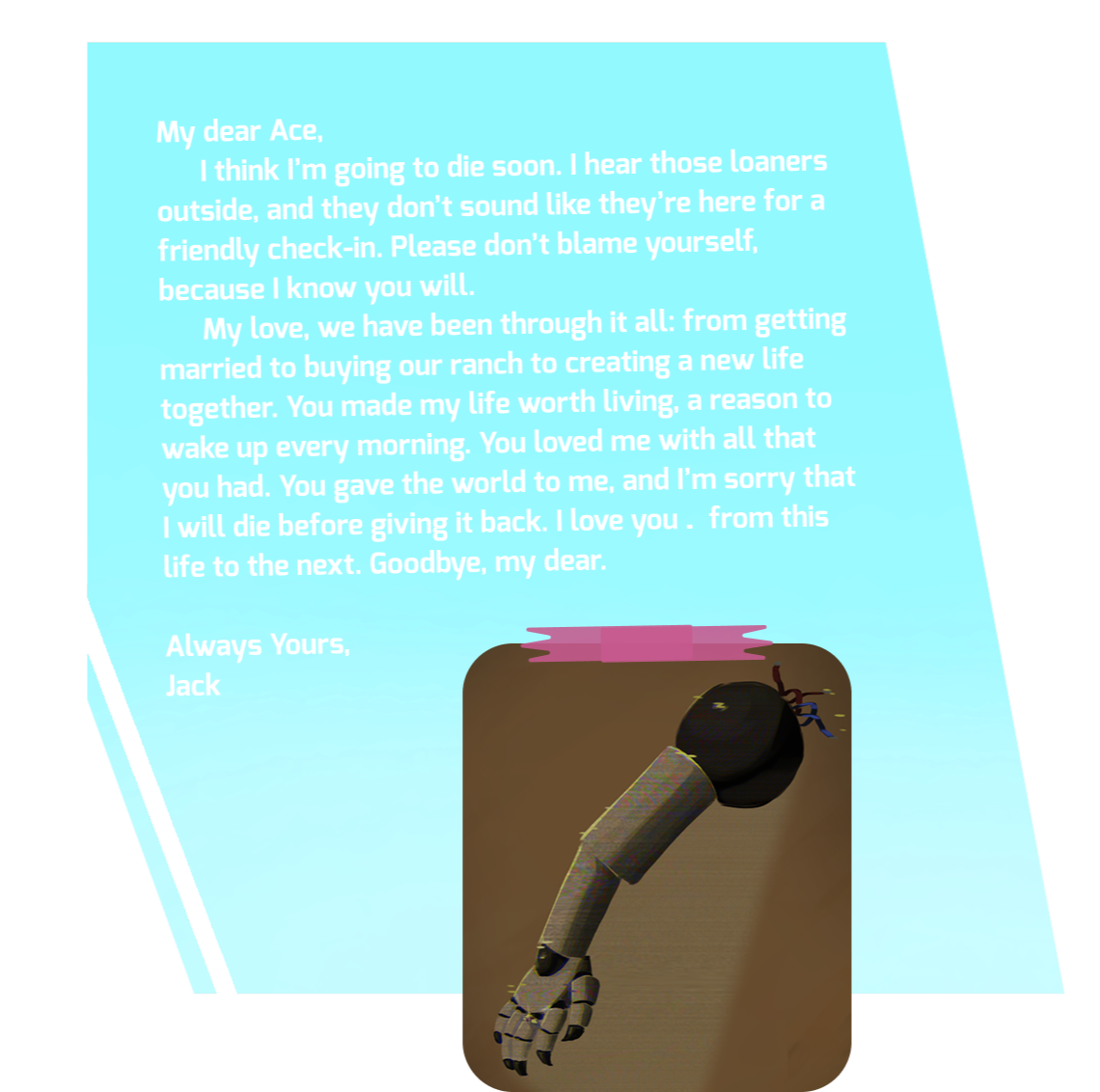
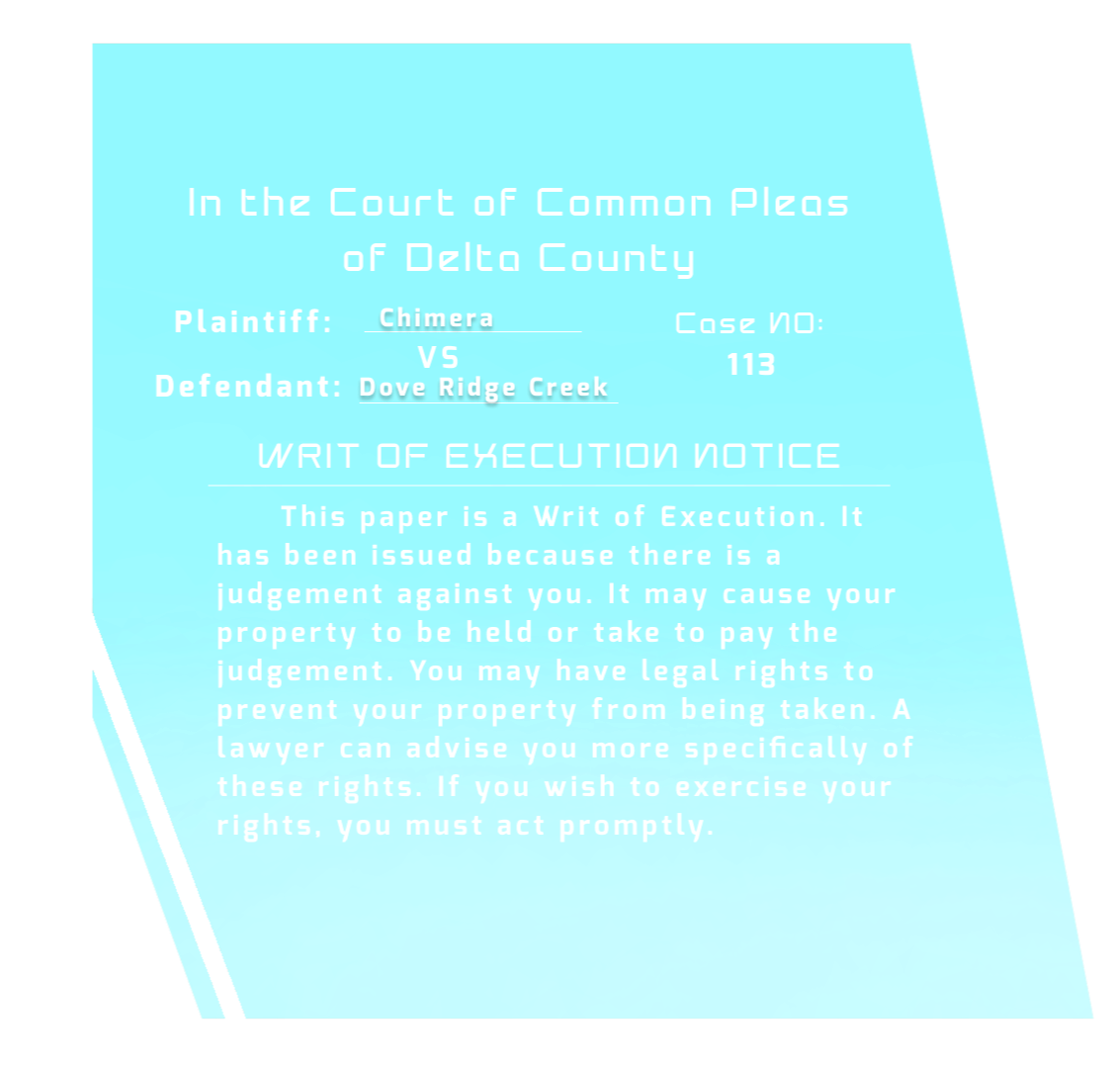
Shop purchases unlock data entries—letters, voice-note transcripts, journal fragments. This was our answer to “no cutscenes”: readable, skippable story that still rewards attention.
Onboarding Entries
The first data entries on spawn establish who Jack is, who Penny was, and why the casino matters—before the player wins a single part.
Shop-Gated Lore
Each purchased part unlocks letters, voice-note transcripts, and journal fragments. Progress in mechanics doubles as progress in emotional arc.
Step 06
Reflection
This was my first large interdisciplinary team project. The biggest lesson: narrative scope has to be expressed as systems and counts—how many barks, how many entries, which beats are mandatory—so production can trust the plan.
Pairing dialogue with data entries kept asset load manageable while preserving clarity and emotion. If I were pitching this to a studio today, I’d lead with the premise reel, then walk constraints, then show one artifact chain end-to-end—the same proof-first order that makes UX case studies like Minecraft easy to scan for hiring managers.